 English
 中文简体
中文简体 Türk
TürkContent
Hot Melt Adhesive Film Applications and Uses
Hot melt adhesive film is used anywhere two materials need a clean, solvent-free bond without the mess or cure time of liquid adhesives, and its uses span far beyond textiles into automotive, electronics, packaging, and footwear manufacturing. What these applications share is a need for consistent, repeatable bonding on a production line — the film's uniform thickness and predictable melt behavior make it far easier to automate than liquid glue dispensing.
Automotive
In automotive interiors, hot melt adhesive film bonds foam to fabric and vinyl to substrate in door panels, headliners, and seat covers, where high-heat-resistant PA or TPU film is typically specified to survive a hot vehicle interior without softening.
Electronics and Optical Bonding
Thin, optically clear hot melt films are used to laminate display layers, touch panels, and flexible circuit components, where precise thickness control and low activation temperature protect sensitive electronic layers during bonding.
Packaging
Lower-cost EVA and PO films are common in flexible packaging lamination, sealing multi-layer pouches and cartons where fast line speeds and low material cost matter more than maximum bond strength.
Footwear
Footwear manufacturers use hot melt adhesive film to bond upper materials, reinforce seams, and attach midsole components, favoring TPU film in areas that flex repeatedly with each step.
Hot Melt Adhesive Film for Fabric and Textile
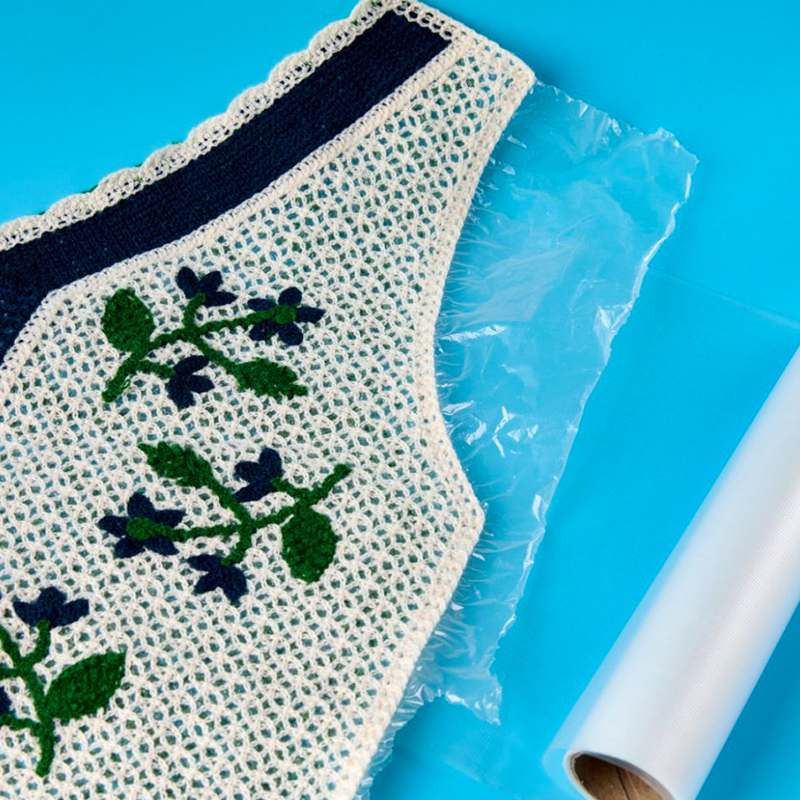
Fabric and textile bonding is one of the largest use cases for hot melt adhesive film, covering everything from garment construction to technical textiles. In apparel, film is used to fuse interlinings, attach appliqué and logos, and bond hems without visible stitching. In technical and outdoor textiles, film is laminated between fabric layers to create waterproof, seam-sealed barriers that stitching alone can't achieve, since needle holes would otherwise let water through.
Fabric type drives film selection more than almost any other factor: stretch fabrics need a film with matching elasticity (TPU is the standard choice) to avoid the bond cracking when the fabric flexes, while woven fabrics with less stretch can use stiffer, lower-cost PES or EVA films without that concern.
Hot Melt Adhesive Film Bonding
The bonding process itself happens in three stages: the film melts under applied heat and becomes a viscous liquid, it flows and wets both substrate surfaces to fill their microscopic surface texture, and it re-solidifies as it cools, mechanically interlocking with the substrate surfaces to form the bond. Bond strength depends on how completely the film wets the substrate during the melt phase — insufficient heat, pressure, or dwell time leaves gaps in surface contact and produces a weaker bond even if the film appears fully melted on the surface.
Substrate surface condition also affects bond quality: oils, dust, or moisture on the bonding surface can prevent proper wetting, which is why cleaning or pre-treating substrates is standard practice before film application in demanding applications.
Hot Melt Adhesive Film Temperature
Getting temperature right is the single most common variable that separates a strong bond from a failed one in production. Too little heat leaves the film only partially melted, producing a weak, patchy bond that can fail under stress or washing; too much heat can scorch heat-sensitive fabrics, distort thin substrates, or degrade the adhesive polymer itself, reducing bond strength even though the film appeared to melt properly. Because heat transfer depends on the full substrate stack — not just the film — production lines typically run trial samples through a range of temperature settings to find the combination that produces consistent, full-coverage bonds before committing to a production run.
How to Use Hot Melt Adhesive Film
- Prepare the substrates — clean both bonding surfaces to remove dust, oils, or moisture that could interfere with wetting
- Position the film — place the film between the two substrates, trimmed to match the bond area, avoiding wrinkles or gaps
- Apply heat and pressure — use a heat press, roller laminator, or ultrasonic welder set to the film's recommended activation temperature, holding pressure for the specified dwell time to ensure full melt-through
- Allow the bond to cool under pressure — where possible, keep pressure applied as the film cools and re-solidifies, since disturbing the bond before it sets can weaken final adhesion
- Inspect the finished bond — check for full surface coverage, no visible gaps or bubbles, and confirm bond strength meets requirements through a peel or shear test before scaling to full production